Peer Review Process
Desk review
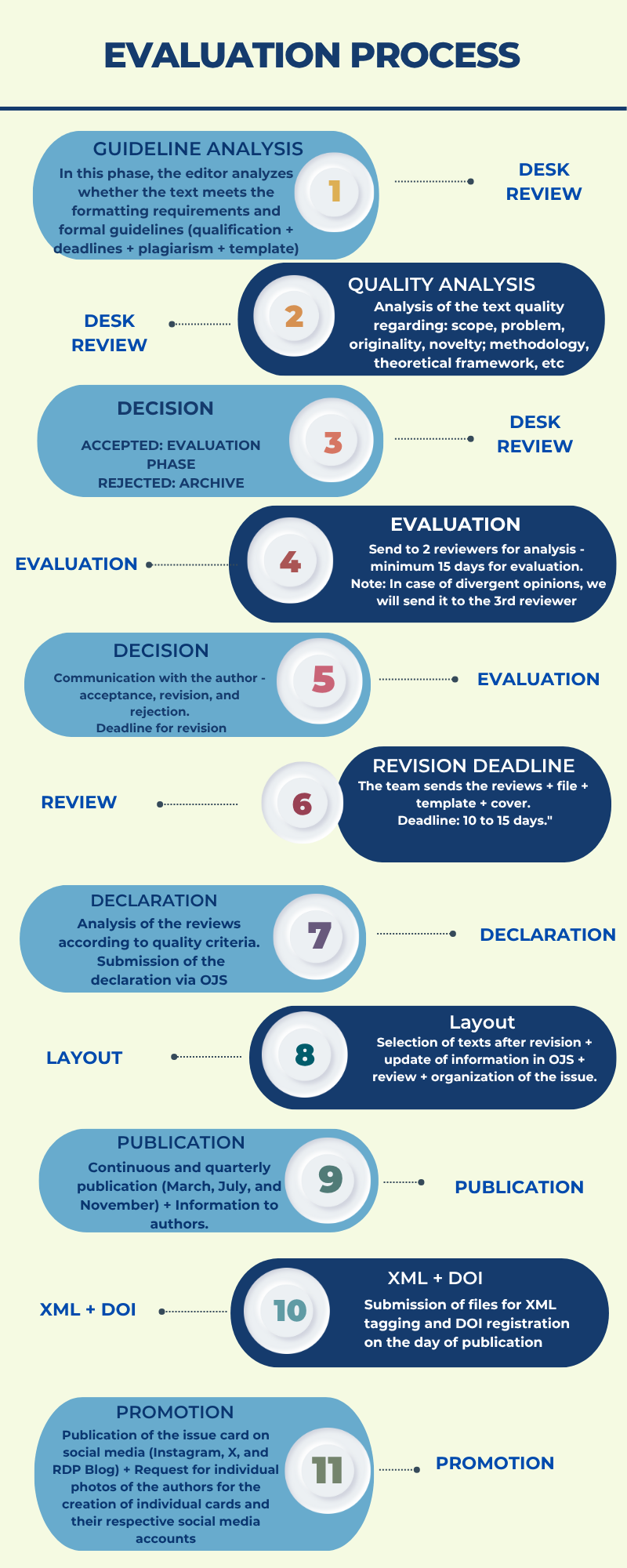
All articles undergo a preliminary analysis by the journal's Executive Committee, which checks that the Guidelines for Authors have been complied with and submits the manuscripts to a plagiarism and self-plagiarism check using the turnitin platform. If the guidelines have not been met, or if plagiarism has been detected, the article will be archived, without prejudice to the possibility of a new submission.
Once the guidelines have been met, the article is analyzed by the Editors, in dialogue with the Editorial Committee, to check that the text is in line with the journal's editorial line, as well as its innovative and unpublished nature. In the event of rejection, the authors are informed of the decision and the article is archived.
In this way, the articles received by Revista Direito Público have two screening filters before starting the evaluation phase:
1 - Initial/formal screening: refers to the analysis of the rules and guidelines for authors, carried out by the Editorial Committee (Editor-in-Chief; Deputy Editor; and Associate Editors). At this stage, the article may be rejected if it does not comply.
2 - Quality Screening: It is up to the Editorial Committee and experts in the field to analyze the article proposal in relation to the Journal's editorial line, which implies a content analysis.
The period for this initial phase of the editorial process is up to 2 (two) months.
Open Peer Review Process:
At the time of manuscript submission, the author may choose to authorize the editorial board to enable direct interaction with the reviewers, thereby waiving the traditional anonymity of the peer review process. This request must be submitted through the "Comments for the Editor" section and must include the explicit consent of all co-authors.
This procedure will only be implemented upon the express agreement of the assigned reviewers. In such cases, the journal adopts the open peer review model, in line with editorial practices that promote transparency, accountability, and constructive dialogue in the scientific review process.
Double-blind peer review process
If approved by the Executive Committee, the article is sent to anonymous referees for a qualitative assessment of its form and content, in accordance with the process known as double-blind peer review.
The articles will be evaluated according to the following criteria: i) formal - compliance with ABNT standards, accuracy of the abstract and keywords; ii) methodological - clarification of the problem it intends to address; development consistent with the objectives proposed; clarification of the methodological options; iii) theoretical - adequate use of the theoretical basis; reflection on the current state of knowledge in the area, containing relevant and up-to-date references; iv) ethical - reference to dubious information in its content or in the references to the sources cited. The novelty and innovation of the work hypothesis will also be taken into account.
The evaluators issue opinions with recommendations and the following positioning: (i) favorable to the publication of the article; (ii) favorable to the publication of the article as long as the suggested changes are made; (iii) not favorable to the publication of the article.
Further evaluation by the editors
After peer review, the editors analyze the opinions issued and categorize the articles into:
i) accepted;
ii) revisions required; and
iii) rejected.
The rejected article will be archived and the opinion sent to the author.However, we emphasize that the rejection decision may be reviewed upon request by the author.
Accepted or partially accepted articles will be sent to the authors so that they can improve them in accordance with the guidelines of the opinion and the editors. Once the changes have been made, the editors will analyze the changes and decide whether the article needs to be further evaluated by peer reviewers or further altered. The purpose of this stage is to further improve the text in dialogue with the editors and referees.
A positive evaluation of the article does not imply publication in the RDP, as there will be a new analysis by the editors, as well as a check for plagiarism and self-plagiarism using the turnitin platform.
Editors' final decision
After exhausting the previous phase, the editors issue a final decision on the article, which may be (i) accepted for publication or (ii) rejected. In the latter case, the article will be archived and the opinion sent to the authors.
The final decision to accept the article does not imply automatic publication, which will be subject to the editors' discretion, based on the current state of the journal's editorial line, the subject of the article and its novelty. In addition, before being considered for publication, the article will be subjected to a new check for plagiarism and self-plagiarism.
Invitations to publish will be sent by e-mail, which must always be updated on the journal's platform.
Exceptionally, there will be invitations to publish articles, but this will not exceed 25% of the articles published in a given year. Invitations will be issued exclusively by the Editor-in-Chief of Revista Direito Público.
Editorial Process Transparency
In line with its commitment to editorial integrity and transparency in peer review, and in accordance with the guidelines established by organizations such as DOAJ, SciELO, and COPE, Revista Direito Público adopts the practice of disclosing, at the end of each published article, key information concerning the editorial workflow. This includes the stages of the review process with their respective dates, the number of reviewers involved in the evaluation, and the identification of the academic editor responsible for overseeing the manuscript. This policy is intended to ensure the traceability of the editorial process and to reinforce the journal’s credibility, accountability, and adherence to ethical standards in scientific communication.
Archiving Policy
Public archiving of submitted articles in preprint and postprint versions is fully permitted and may be done on any open-access server, indexer, repository, or personal website, such as Academia.edu and ResearchGate.
The OJS system used by our journal is hosted on Periódicos em Nuvens, ensuring that backup copies are regularly updated.
Publication Order
The publication of manuscripts approved through peer review and selected by the journal's editorial team follows, as a general rule, the chronological order of submission and approval, except in cases involving invited authors.
However, in accordance with the guidelines established by the the SciELO platform, prioritization criteria for the evaluation and publication of specific works apply. These criteria, which may be observed by authors seeking greater speed in the editorial process, include factors such as institutional exogeneity, manuscript language, the authors’ academic qualifications, and the presence of public funding for the research.
Additionally, at the discretion of the editorial team of the Journal, manuscripts addressing issues of urgent contemporary relevance may be prioritized, particularly when the scientific content could become obsolete due to publication delays. This situation may be identified by the editorial team or suggested by reviewers during the evaluation process.
It is important to note that the criteria outlined in this section establish preferences in the editorial flow, but do not constitute mandatory requirements for manuscript submission or acceptance. For example, although manuscripts authored by researchers with doctoral degrees are given preference, the absence of such a degree does not prevent publication. All submissions will be evaluated based on uniform technical and scientific criteria, with the aim of ensuring the academic and editorial quality of the journal.
Editorial Flow – Thematic Sections:
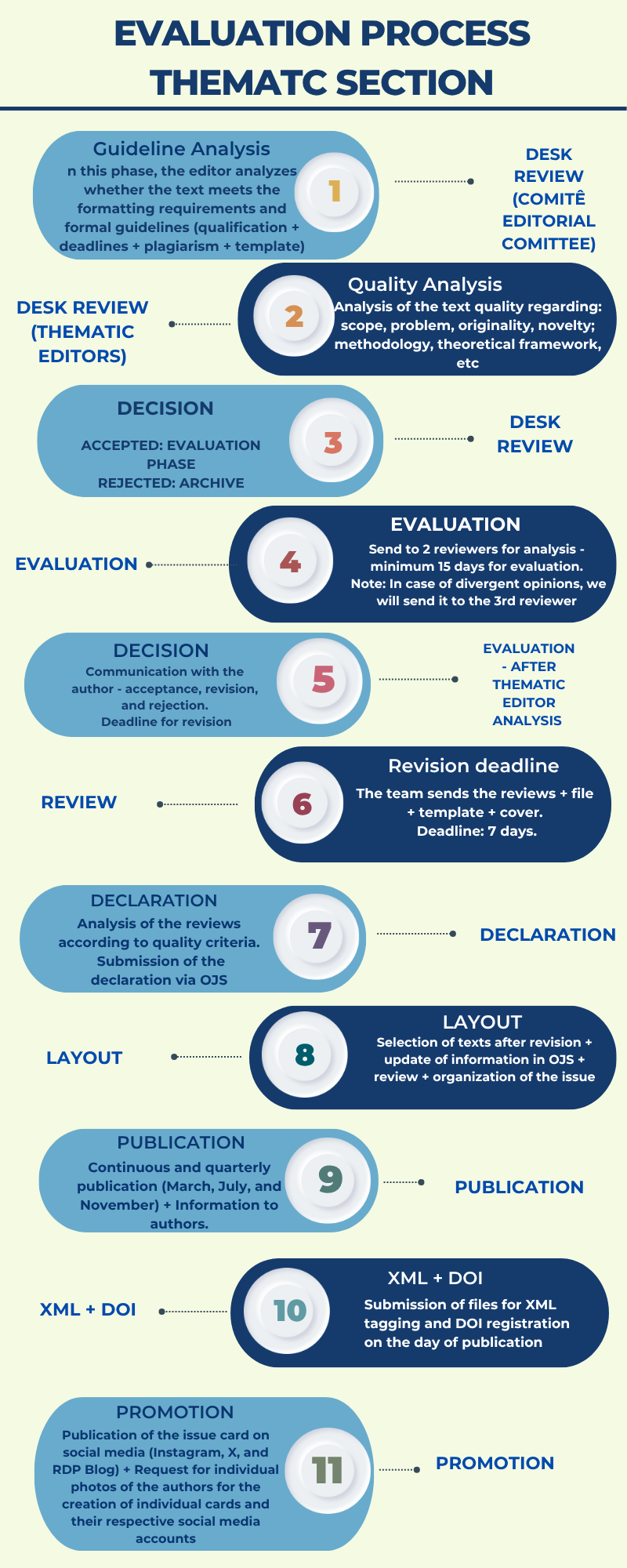
1.Choosing the theme of the thematic section, together with the coordinators. At this stage, the choice is made
- A) Through a call for proposals called “Calls for Thematic Sections”, in which the editorial board opens up to the academic community, indicating innovative themes that have not been worked on by the journal recently;
- B) By invitation, in which the reason for the choice is the relevance of the theme in the area of Public Law combined with the elements of regionality and internationalization of the organizers and the involvement of their research agenda with the theme, analyzed by the Committee.
- dialog with future coordinators, informing them of the editorial rules and the flow of the editorial process. At this stage, a manual will be made available to the coordinators to help them understand the flow and we will reinforce the importance of blind review in the evaluation phase, unless the possibility of open evaluation is requested by those involved in the evaluation process (authors and referees);
- Sending the updated proposal, according to the journal's internal deadlines, and defining the phases of the thematic dossier;
- Opening of the call for submissions, indicating the start and end dates, as well as publication on the journal's website and social media. At this stage, the author can indicate whether they wish to have their identity revealed.
- After the submission is closed, the guidelines screening phase begins, in which the editors analyze whether the submission complies with the Guidelines for Authors, which involves submission conditions (Item 7.1); Manuscript Formatting Requirements (7.2); and. checking for plagiarism using the Turnitin program.
5.1 At this stage, the Committee's deadline for screening Guidelines can be up to one month after the end of the dossier, depending on demand. We explain that at this stage, the Editorial Committee communicates rejection if the text does not meet the requirements, or makes a request for adaptation if it is a one-off modification that does not violate the rules of the Guidelines; texts that pass the guidelines screening while meeting the requirements go on to quality screening.
- After the screening of guidelines, the quality screening phase begins, in which the dossier coordinators are responsible for making the proposal and defining the theme. At this stage, the Committee makes the anonymous texts available on a drive, where internal management is carried out and viewed by a platform that only editors can use, with a specific field for annotations, thus maintaining the blind review until the evaluation stage. The time given to coordinators for quality screening can be up to one month.
- At the end of the quality screening, the editors are responsible for communicating the rejection decision, if indicated by the coordinators, together with the reasons for the decision. The texts that pass the quality screening proceed to the evaluation phase. This communication can take up to 2 (two) weeks.
- In the evaluation phase, two referees are appointed who are specialists in the subject of the dossier and have 15 (fifteen) days to carry out the evaluation. If the evaluation request is not accepted, another reviewer will be appointed.
8.1. If the two referees issue discrepant evaluations, a third referee will be appointed.
8.2 For the thematic dossier, the referees' evaluations are made available to the coordinators in a folder on the drive.
8.3 The evaluation phase for the thematic section can last up to 4 (four) months, however, we value the speed and quality of the evaluations, so this period can be shorter.
- Once the evaluations have been completed, and depending on the decisions made, the editorial committee may issue a decision on acceptance, mandatory corrections or rejection, the latter of which will be communicated shortly.
9.1 For the decision on mandatory corrections, the Editorial Committee stipulates an average of 7 (seven) to 10 (ten) days for the authors to make the corrections, with the possibility of an extension.
9.2 Together with the editorial decision to accept or make corrections, the Committee will send the template and cover sheet, which the authors must fill in and submit in the model.
- After sending the corrected version, the Committee may send it again for the referees to analyze and for the coordinators to analyze and choose the texts that comply with the proposal and present scientific quality in the area.
- During this period, rejections and acceptances will be sent out, the latter being subject to a second review and checking in the plagiarism program, turnitin.
- Once the accepted texts have been checked, the coordinators send the summary and editorial letter and the text editing phase begins.
- The Text Editing phase is when the editors check that the text is in the template and complies with the formatting rules, as well as grammar and agreement adjustments, which are the responsibility of the authors. This phase takes around 5 (five) to 7 (seven) days.
- The last phase of the process is Publishing, where there is a final check of the information, metadata of the authors and the text; completion of the deadlines for the editorial process and the editor responsible for the text; completion of the DOI and adjustments regarding the new edition, such as scheduling for publication and subsequent publication.
- Once the issue/text has been published, an email is sent to the journal's users, informing them, as well as communicating with the scientific community via our social media (Instagram, X and Blog). And a thank-you e-mail is sent to the authors containing information about the issue, the promotional card, together with a request to send photos and social networks for the scientific dissemination of the texts.
- There is a new phase of revision by the editorial team of the issue, comprising the post-publication phase. During this period, the texts are sent for XML marking, which is inserted into the Revista Direito Público website.
- For the thematic sections, the Public Law Journal includes them in the “Dialogues in Public Law” project, in which it transforms the dossier into a mini-course, open to the general public, with the aim of disseminating science and fostering research networks. The proposal is for the coordinators to present the proposal and the results of the dossier and for the authors to present their research and their research agenda.;