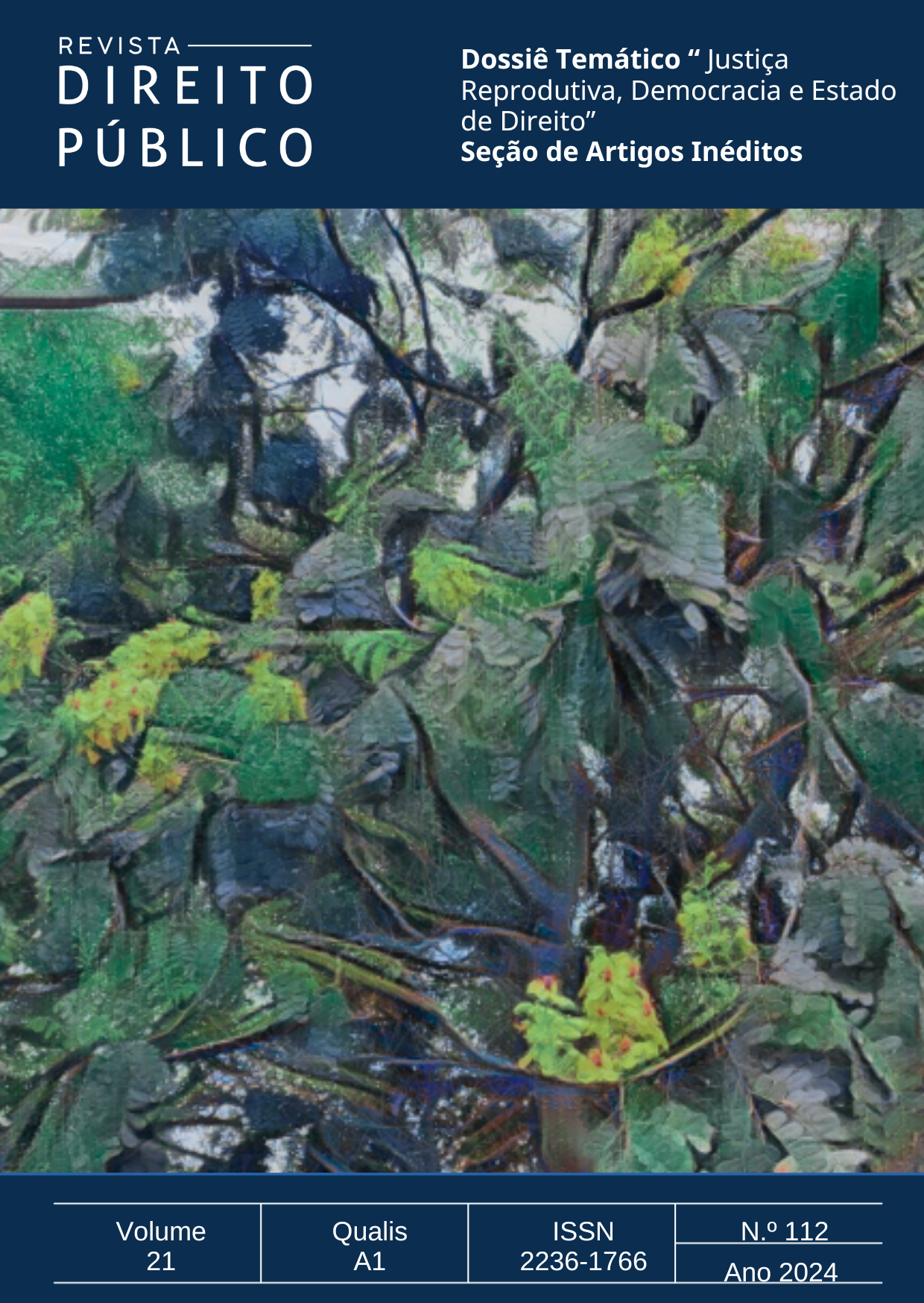
Presentación del dossier temático
Desarrollo de un enfoque sociológico para analizar la relación entre Justicia Reproductiva, Democracia y Estado de Derecho en Brasil
DOI:
https://doi.org/10.11117/rdp.v21i112.8237Resumen
Presentación del dossier temático "Justicia reproductiva, democracia y Estado de derecho en Brasil"
Descargas
Citas
ARMIJO, L. Review of ‘Conceptual orientations and recent debates on care: strategies, resistances, vulnerabilities and reproductive justice’, IV Latin American Congress of Social Theory, Santiago, Chile, 7–10 March 2023. International Journal of Care and Caring, v. 7, n. 3, p. 574-575, 2023. DOI: https://doi.org/10.1332/239788223X16857179106014
BARRANCOS, Dora. Historia mínima de los feminismos en América Latina. Cidade do México: El Colegio de México, 2020. DOI: https://doi.org/10.2307/j.ctv19rs0bk
BEISEL, Nicola; KAY, Tamara. Abortion, Race, and Gender in Nineteenth-Century America. American Sociological Review, v. 69, n. 4, p. 498–518, 2004. DOI: https://doi.org/10.1177/000312240406900402
BERGALLO, Paola; RAMÓN MICHEL, Agustina. Constitutional Developments in Latin American Abortion Law. Int’L J. Gynecol. & Obstet., v. 135, n. 228, 2016. DOI: https://doi.org/10.1016/j.ijgo.2016.08.002
BOND, Johanna. Zika, feminism, and the failures of health policy.Wash. & Lee L. Rev. Online 73, v. 841, 2016.
BUCHOLC, Marta. Commemorative Lawmaking: Memory Frames of the Democratic Backsliding in Poland After 2015. Hague J. Rule, v. 11, p. 85-86, 2019. DOI: https://doi.org/10.1007/s40803-018-0080-7
CEDAW Committee, Comm. No. 17/2008, U.N. Doc. CEDAW/C/49/177/2008, Alyne da Silva Pimentel v. Brazil (Sept. 27, 2011).
Centre for Reproductive Rights, The Green Wave Reaches Brazil: Supreme Court to Decide on Abortion Decriminalization, 22 September 2023, available at: https://reproductiverights.org/green-wave-brazil-supreme-court/
COLETIVO MARGARIDA ALVES. Guia de Defesa Popular da Justiça Reprodutiva, 2020. Available at: https://www.mulheres.org.br/wp-content/uploads/2020/02/guia-defesa-popular-justica-reprodutiva.pdf
COLLINS, PH, Collins. Black Feminist Thought: Knowledge, Consciousness, and the Politics of Empowerment. Boston: Unwin Hyman, 1990.
COLLUCI, Claudia. Brazilian attorneys demand abortion rights for women infected with Zika. BMJ v. 354, n. 4657, 2016. DOI: https://doi.org/10.1136/bmj.i4657
CRIOLA. Dossiê Mulheres Negras e Justiça Reprodutiva, 2024. Available at: https://criola.org.br/criola-lanca-dossie-mulheres-negras-e-justica-reprodutiva-nesta-sexta-feira-01-10-as-19h/?doing_wp_cron=1738274991.6355390548706054687500.
CZARNOTA, Adam; KRYGIER, Martin. Po komunizmie—Następny Etap? [After Communism—The next stage?]. Studia Socjologiczne v.2, p. 145-161, 2006.
DE ZORDO, S. 2016 The biomedicalisation of illegal abortion: The double life of misoprostol in Brazil. História, Ciências, Saúde-Manguinhos, v. 23, n. 1, p. 19–35, 2016. DOI: https://doi.org/10.1590/S0104-59702016000100003
DINIZ,, D; AMBROGI, I. Research ethics and the Zika legacy in Brazil. Developing World Bioethics, v. 17, p. 142–143, 2017. DOI: https://doi.org/10.1111/dewb.12175
DRINOT, Paulo. The Sexual Question: A History of Prostitution in Peru, 1850s–1950s. Nova York: Cambridge University Press, 2020. DOI: https://doi.org/10.1017/9781108675659
FRIEDMAN, Elisabeth Jay. Seeking Rights from the Left: Gender, Sexuality, and the Latin American Pink Tide. NC: Duke University Press, 2019. DOI: https://doi.org/10.1515/9781478002604
GOODWIN, Michele. Involuntary Reproductive Servitude: Forced Pregnancy, Abortion, and the Thirteenth Amendment. U. Chi. Legal F., v. 191, 2022.
GUZZO, Morgani. Justiça Reprodutiva para todos: saúde, gestação e parentalidades dissidentes. Available at: https://catarinas.info/wp-content/uploads/2016/07/Cartilha-Justica-Reprodutiva-para-Todes.pdf
HARTMAN, Saidya. Scenes of Subjection: Terror, Slavery, and Self-Making in Nineteenth-Century America. New York: Oxford University Press, 1997.
HIRSCHMANN, Nancy J. Abortion, Self-Defense, and Involuntary Servitude. Tex. J. Women & L., v. 13, n. 41, 2003.
JENKINS SCHWARTZ, Marie. Birthing a Slave: Motherhood and Medicine in the Antebellum South. Cambridge: Harvard University Press, 2010. DOI: https://doi.org/10.2307/j.ctv1n1bscg
JOHNSON, C. Pregnant woman versus mosquito: A feminist epidemiology of Zika virus. Politics and Ethics Review, v. 12, n. 2, p. 233–250, 2017. DOI: https://doi.org/10.1177/1755088217702671
KIMBALL, Natalie L.. New Brunswick, An Open Secret: The History of Unwanted Pregnancy and Abortion in Modern Bolivia. NJ: Rutgers University Press, 2020. DOI: https://doi.org/10.36019/9780813590776
KING, DK. Multiple jeopardy, multiple consciousness: the context of a black feminist ideology. Signs: J.Women Cult. Soc. n. 14, p. 42–72, 1998. DOI: https://doi.org/10.1086/494491
KOMMERS, Donald. P, Abortion and Constitution: United States and West Germany. Am. J. Comp. L., v. 25, n. 255, 1977. DOI: https://doi.org/10.2307/839841
KURCZEWSKI, Jacek. Prawem i Lewem. Kultura Prawna Społeczeństwa Polskiego po Komunizmie [Right and Left. Legal Culture of Polish Society After Communism]. Studia Socjologiczne v.2, p. 33-34, 2007.
LATIMER, Heather. Abortion Regulation as the Afterlife of Reproductive Slavery: Or, a Call to Make Abortion Natural Again. Feminist Studies, v. 48, n. 2, p. 342-366, 2022. DOI: https://doi.org/10.1353/fem.2022.0030
LEITE, Tatiana Henriques, et al. Disrespect and abuse, mistreatment and obstetric violence: a challenge for epidemiology and public health in Brazil. Ciência & Saúde Coletiva, n. 27, p. 483-491, 2022.
LUKER, Kristin. Abortion and the Politics of Motherhood. California: University of California Press, 1984.
LUNA, Z. From rights to justice: Women of color changing the face of us reproductive rights organizing. Societies without Borders, v. 4, p. 343–365, 2009. DOI: https://doi.org/10.1163/187188609X12492771031618
MALGORZARA, Fuszara. Citizenship, Representation and Gender. Polish Socio. Rev., v. 172, n. 367, 2010.
MANSO SIQUEIRA, Lia Maria. DOSSIÊ: Mulheres Negras e Justiça Reprodutiva. Criola: Rio de Janeiro, 2021.
MARCUS-DELGADO, Jane. The Politics of Abortion in Latin America: Public Debates, Private Lives. Boulder, CO: Lynne Rienner Publishers, 2019. DOI: https://doi.org/10.1515/9781626378421
MARINO, Katherine M..Feminism for the Americas: The Making of an International Human Rights Movement. Chapel Hill: University of North Carolina Press, 2019. DOI: https://doi.org/10.5149/northcarolina/9781469649696.001.0001
McCONNELL, Joyce E. Beyond metaphor: battered women, involuntary servitude and the thirteenth amendment. Yale JL & Feminism, v. 4, n. 207, 1991.
MISHTAL, Joanna. The Politics of Morality: The Church, the State, and Reproductive Rights in Post-socialist Poland. Ohio: Ohio University Press, 2015.
MORGAN, Jennifer L.. Reckoning with Slavery: Gender, Kinship, and Capitalism in the Early Black Atlantic. Durham, NC: Duke University Press, 2021. DOI: https://doi.org/10.1515/9781478021452
MORGAN, Lynn. Reproductive Rights or Reproductive Justice? Lessons from Argentina. Health & Hum Rts, v. 17, n.1, 2015. DOI: https://doi.org/10.2307/healhumarigh.17.1.136
MOSELEY-MORRIS, Kelcie. Slavery rhetoric has long been part of abortion debate. ‘Abolitionists’ take it to next level. Kansas Reflector. Available via: https://kansasreflector.com/2023/08/31/slavery-rhetoric-has-long-been-part-of-abortion-politics-abolitionists-take-it-to-the-next-level/. Last access: 31 August 2024.
NADING, A; LOWE, L. Social Justice as Epidemic Control: Two Latin American Case Studies. Medical Anthropology, v. 37, n. 6, p. 458–471, 2018. DOI: https://doi.org/10.1080/01459740.2018.1485021
NOLAN, R. Reproductive Justice in Latin America. Latin American Research Review, v. 57, n. 4, p. 948-959, 2022. DOI: https://doi.org/10.1017/lar.2022.73
O’CONNELL, Ciara. Litigating Reproductive Health Rights in the Inter-American System: What Does a Winning Case Look Like? HEALTH &HUM.RTS.J., v. 16, p. 116-120, 2014. DOI: https://doi.org/10.2139/ssrn.2553649
OJA, Liiri, YAMIN, Alicia Ely. “Woman” in the European Human Rights System: How is the Reproductive Rights Jurisprudence of the European Court of Human Rights Constructing Narratives of Women’s Citizenship? COLUM. J. GENDER & L., v. 32, n. 62, 2016.
PARO, H.B. H. B. M. d. S.; CATANI, R. R., CORDEIRO FREIRE, R.; RONDON, Rondon, G. Bottom-up advocacy strategies to abortion access during the COVID-19 pandemic: Lessons learned towards reproductive justice in Brazil. Developing World Bioethics, v. 23, p. 147–153, 2023.
PETCHESKY,, Rosalind P. Abortion and Woman’s Choice: The State, Sexuality, and Reproductive Freedom. New York: Verso, 1997.
PLUMMER, Kenneth. Intimate Citizenship: Private Decisions and Public Dialogues In: Sasha Roseniel (ed). Beyond Citizenship? Feminism and the Transformation of Belonging. New York: Springer, 2013.
PRANDINI, Assis, M.; LARREA, Sara. Why self-managed abortion is so much more than a provisional solution for times of pandemic. Sexual and Reproductive Health Matters, v. 28, n.1, 2020. DOI: https://doi.org/10.1080/26410397.2020.1779633
RABIONET, Silvia E., et al. Pregnancy and Zika: the quest for quality care and reproductive justice. Puerto Rico health sciences journal v. 37, p. 45-50, 2018.
ROBERTS, Dorothy E.. Killing the Black Body: Race, Reproduction, and the Meaning of Liberty. New York: Pantheon Books, 1997.
RONDON, G.; BRITO, L. Reproductive Justice Lessons for Catalyzing Advocacy Strategies during Zika Crisis in Brazil. Physis: Revista de Saúde Coletiva, 2024.
RONDON, G.; CORDEIRO FREIRE, R.; CATANI, R.R.; PARO, H. Bottom-up advocacy strategies to abortion access during the COVID-19 pandemic: Lessons learned towards reproductive justice in Brazil. Developing World Bioethics, v. 23, p. 147-153, 2023. DOI: https://doi.org/10.1111/dewb.12368
RONDON, Gabriela; DINIZ, Débora; ZAIDEN BENVINDO, Juliano. Speaking truth to power: Legal scholars as survivors and witnesses of the Covid-19 maternal mortality in Brazil. International Journal of Constitutional Law, v. 20, n. 3, p. 1360–1369, 2022. DOI: https://doi.org/10.1093/icon/moac066
ROTH, Cassia. A Miscarriage of Justice: Women’s Reproductive Lives and the Law in Early Twentieth-Century Brazil. Stanford, CA: Stanford University Press, 2020. DOI: https://doi.org/10.1515/9781503611337
RUTH, Lister. Citizenship: Feminist Perspectives. New York: Springer, 1997. DOI: https://doi.org/10.1007/978-1-349-26209-0
SADURSKI, Wojciech. Poland’s Constitutional Breakdown. Oxford: Oxford University Press, 2019. DOI: https://doi.org/10.1093/oso/9780198840503.001.0001
SCHIOCCHET, Taysa; MARTINUZZI CASTILHO, Natalia. Justiça Reprodutiva no Brasil. Rio de Janeiro: Multifoco, 2024.
SCHIOCCHET, Taysa; MATTOS DE ARAGÃO, Suelly. Jurisprudential Overview of Obstetric Violence and Discursive Analysis of the Court Decisions in Southern Brazil. DIREITO GV L. Rev., v. 19, n. 1, 2023. DOI: https://doi.org/10.1590/2317-6172202321
SIEDER, Rachel. Demanding Justice and Security: Indigenous Women and Legal Pluralities in Latin America. New Brunswick, NJ: Rutgers University Press, 2017.
SIEGEL, Reva B. The Constitutionalization of Abortion, in Abortion Law in Transnational Perspective. In: Rebecca J. Cook, Joanna N. Erdman & Bernard M. Dickens (eds), Abortion Law in Transnational Perspective. Pennsylvania: University of Pennsylvania Press, 2014. DOI: https://doi.org/10.9783/9780812209990.13
SILIMAN, J. M.; ROSS, L., GUTIÉRREZ, E. R.; FRIED, M. G. Undivided rights: Women of color organizing for reproductive justice. Chicago, IL: Haymarket Books, 2016.
SPAPSKA, Grażyna. Civic and Legal Cultures in Spain and Poland. Polish Socio. Rev., v. 126, p. 223-225, 1999.
STERN, Alexandra Minna. Zika and Reproductive Justice. Cad. Saúde Pública v. 32, n. 5, 2016. DOI: https://doi.org/10.1590/0102-311X00081516
UNFPA, High-Level Commission on the Nairobi Summit on ICPD25, “No Exceptions, No Exclusions: Realizing Sexual and Reproductive Health, Rights and Justice for All”, 2021, 2022.
UNFPA. Advancing Sexual and Reproductive Health and Rights in the Private Sector: The Case for Action and Accountability in the workplace. New York: United Nations Population Fund, 2024.
VALENTE, Pablo K. Zika and Reproductive Rights in Brazil: Challenge to the Right to Health. American Journal of Public Health v. 107, p. 1376-1380, 2017. DOI: https://doi.org/10.2105/AJPH.2017.303924
WEINBAUM, Alys Eve. The Afterlife of Reproductive Slavery: Biocapitalism and Black Feminism’s Philosophy of History. Durham, NC: Duke University Press, 2019. DOI: https://doi.org/10.1515/9781478003281
WEINGARTEN, Karen. Abortion in the American Imagination: Before Life and Choice, 1880–1940. New Brunswick, NJ: Rutgers University Press, 2014.
WEINGAST, Barry. A Postscript to Political Foundations of Democracy and the Rule of Law. In: MARAVALL, Jose Maria; PRZEWORSKI, Adam. Democracy and the Rule of Law. Cambridge: Cambridge University Press, 2009.
Publicado
Cómo citar
Número
Sección
Licencia
Derechos de autor 2025 Direito Público

Esta obra está bajo una licencia internacional Creative Commons Atribución-NoComercial 4.0.
O(s)/A(s) autores(as) dos manuscritos submetidos concorda(m) com as regras a seguir:
1) Todos os autores e autoras participaram do trabalho, são responsáveis pelas ideias e conceitos nele emitidos e atestam sua conformidade com os princípios éticos exigidos.
2) Todos os autores e autoras concordam com a forma final do trabalho e em ceder os direitos para publicação nos canais de publicação da Escola de Direito do IDP.
3) Todos os autores e autoras informam que o manuscrito é de sua autoria e assumem a responsabilidade pelo trabalho, declarando que a obra a ser publicada não infringe quaisquer direitos de propriedade intelectual de terceiros.
3.1) Em caso de submissão simultânea, além da reprovação imediata do artigo e comunicação ao(s) respectivo(s) periódico(s), a Revista Direito Público se reserva o direito de não receber novas submissões de todos os autores implicados pelo prazo de 2 (dois) anos, contado a partir da data de ciência do fato.
4) Todos os autores e autoras autoriza(m) a edição de seu trabalho e cede(m) à Escola de Direito do IDP os direitos de autor para reproduzir, editar e publicar ou veicular o citado trabalho em qualquer forma midiática, resguardada a autoria, em particular sob forma digital, em arquivo eletrônico online na Internet, bem como armazená-los em seu repositório de acordo com o desenvolvimento do processo editorial. Esta concessão não terá caráter oneroso para a Escola de Direito do IDP, não havendo remuneração sob qualquer modalidade pela utilização do referido material, tendo este o caráter de colaboração científica.